To unlock the full potential of artificial intelligence, it must be applied in practical scenarios. Only when AI can provide actionable insights does its true value become evident. If we consider AI as akin to human cognition, then its technical components, such as algorithms and data processing, can be likened to the hands, eyes, and physical actions of humans. Through these components, AI’s decision-making capabilities are put into practice. Below, we introduce some widely applied and rapidly advancing AI technologies.
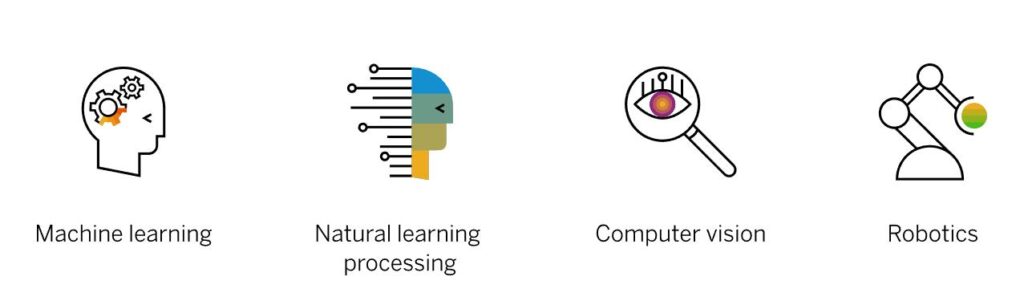
Artificial Intelligence Technologies
Machine Learning
Machine learning, along with all its components, is a subset of artificial intelligence. It applies various algorithms to different types of learning methods and analytical techniques, allowing systems to automatically learn from experience and continuously improve without explicit programming. Enterprises can leverage machine learning to address any problem or objective requiring predictive outcomes, which necessitate complex data analysis.
What distinguishes artificial intelligence from machine learning? Machine learning is a subset of artificial intelligence; without AI, there would be no machine learning. Thus, the important aspect is not that they are mutually exclusive but rather how they differ. Artificial intelligence involves decision-making and prediction based on data processing. With machine learning algorithms, AI not only processes data but also learns from it without the need for additional programming, thus becoming smarter.
Natural Language Processing (NLP)
In the field of artificial intelligence, NLP technology enables machines to recognize and understand written language and spoken commands, including translating human language into language comprehensible by algorithms. Natural Language Generation (NLG), as a subset of NLP, allows AI systems to convert digital language into natural human language. In more complex scenarios, NLP can also utilize context to infer attitudes, emotions, and other subjective traits to interpret meanings more accurately. NLP finds broad practical applications, including chatbots and digital voice assistants like Siri and Alexa, which enhance our interactions through intelligent NLP-driven experiences.
Computer Vision
Computer vision is a methodology that helps computers view and understand digital images and videos, not just recognize or classify them. Through AI’s deep learning, computer vision can also extrapolate data for predictions, essentially enabling it to see through walls and not miss any details. Autonomous vehicles represent an excellent example of the combined application of computer vision and artificial intelligence.

Robotics Technology
Robotics technology is not a novelty, having been utilized for years in industries like manufacturing. However, without AI, automation operations could only be achieved through manual programming and calibration. If these workflows had flaws or inefficient aspects, they could only be discovered post-implementation or after a malfunction occurred. Operators often remained unaware of the causes of problems and had no clue about what adjustments to make to enhance efficiency and productivity. However, with the introduction of AI, usually after adopting IoT sensors, the range, quantity, and types of tasks performed by robots can be significantly expanded. Industrial applications of robotics technology include large-scale warehouse picking robots and agricultural robots capable of picking or maintaining crops at optimal times, programmable to execute tasks efficiently.
Enterprise AI Applications
The application of AI in enterprises brings numerous benefits and competitive advantages to businesses of various scales and across different industries. Increasingly, businesses recognize the indispensable role of AI in their operational activities. Particularly in industries such as healthcare and banking, where extensive and sensitive datasets exist, the value of artificial intelligence has been evident since its early stages of development. However, considering the scope and accessibility of modern AI applications, AI-related solutions can cover almost all business models. Below are examples from various industries:
AI Applications in Healthcare
Medical datasets constitute one of the largest, most complex, and sensitive datasets globally. One key application area of AI in the healthcare industry is leveraging data to discover relationships between diagnoses, treatment plans, and patient outcomes. Additionally, hospitals seek AI solutions to support other operational areas and initiatives, including optimizing staff teams, enhancing staff and patient satisfaction, and cost-saving measures.
AI Applications in Banking
Banks and financial institutions have stringent requirements regarding security, compliance, and transaction speed, making them one of the earliest adopters of AI technology. Functionalities such as AI-powered chatbots, digital payment advisors, and biometric fraud detection mechanisms help banks improve efficiency and customer service levels while reducing risks and fraud. Learn how banks leverage digitalization and intelligent technologies to provide end-to-end services.
AI Applications in Manufacturing
Devices and machines interconnected, transmitting and receiving data through central systems, form an Internet of Things (IoT) network. AI can not only process this information but also utilize it to predict business disruptions and opportunities, automatically executing the most suitable tasks and workflows based on specific circumstances. In smart factories, the scope of AI application extends to on-demand production protocols for 3D printers and virtual inventory domains. Learn how companies like Adidas utilize machine learning to deliver customized sports shoes within just 24 hours.
AI Applications in Retail
The COVID-19 pandemic has significantly altered people’s shopping habits, with a notable increase in online shopping compared to the previous year. These changes have created an intensely competitive and rapidly changing commercial environment for retailers. Online shoppers continuously explore various customer touchpoints, resulting in more complex, unstructured data than ever before. To fully understand and leverage this data, retailers hope to utilize AI solutions to process and analyze dispersed datasets, providing useful insights and engaging in real-time interactions with customers. Learn how to utilize digitalization and intelligent technologies to address the challenges and opportunities of the new era in the retail industry.
AI Applications in Agriculture
In the agricultural sector, AI applications not only help increase yields but also drive innovation research towards sustainability. AI’s predictive capabilities also help improve agricultural efficiency and food supply chain efficiency. For example, predictive analysis tools can inform farmers of the optimal time to harvest different types of crops by evaluating factors such as ripening schedules, weather conditions, and distance to the market. This includes prompting the automation of workflows for agricultural robots, enabling them to automatically harvest and process specified quantities of crops at specific times. Learn how intelligent technologies can drive sustainable development and crop growth in agriculture.